
CellControl
Electronic batch records for autologous cell therapy manufacturing.
Operators are guided step by step on a cleanroom touch screen. Every label and sample is tied to the patient’s chain of identity and checked when it is scanned. And supervisors learn early when a culture is unlikely to reach its dose, while there is still time to act.
Pilot programme: accepting two pilot partners for 2027.
Illustration: CAR-T cell binding a tumour cell · not to scale
Why it exists
An autologous batch is made for one patient. A mix-up, a missed sample or a culture that will not reach its dose has consequences no other kind of manufacturing has. Paper records and general-purpose systems leave it to people to cross-check these things by hand. CellControl puts the checks where the work happens, on the operator’s screen and at the scanner, and keeps the evidence in one batch record that QA can review by exception.
Key Capabilities
Chain of identity from patient to bag
The patient's chain-of-identity number travels with every task, sample and label. It is checked again when items are scanned at the points that matter.
Label control and reconciliation
Each label has a unique ID and a per-batch sequence number. Printed, applied, voided and reprinted labels are counted, so the batch record shows what happened to every one.
Samples handed to QC with notification
When manufacturing draws a sample and hands it over, QC is notified. Results are entered against the specification in the product recipe and approved by a second person.
Product recipe as the reference
Parameter ranges for each day, the growth needed for the dose and the QC specifications are kept in an approved recipe that is frozen into each batch at start.
Early warning to supervision
Out-of-range results, slowing growth, identity failures and STOP scans raise an in-app notification for the people who need to act, at the right site.
Review and release with electronic signatures
Every change is written to the audit trail. Review and release are signed electronically by authorised QA users, with the meaning of each signature recorded.
At a glance
Regulatory position
CellControl is designed to support the controls expected under 21 CFR Part 11 and EU GMP Annex 11: individual user accounts, electronic signatures that record their meaning, a complete audit trail and role-based access. Software alone does not make a process compliant. Computerised-system validation is carried out for each installation by the manufacturer, and we support your QA team in that work.
What your team sees
Screens from the CellControl demonstration system. All patients, batches and results shown are fictitious.
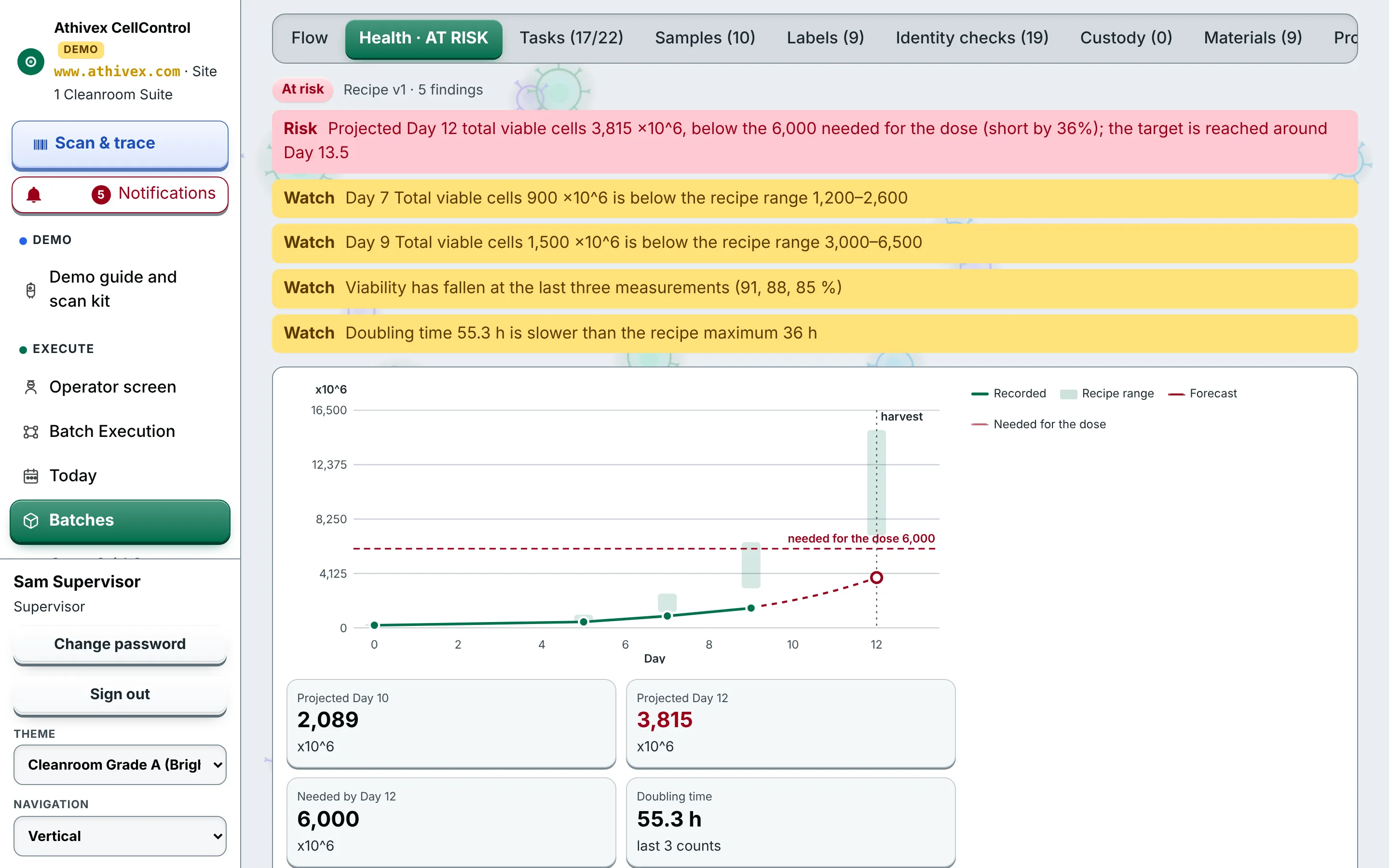
See on Day 9 whether the dose will be reached
Each in-process count is compared with the product recipe. CellControl projects the cell count at harvest and flags the batch when the forecast falls short, so the culture decision is made with the numbers in front of you.
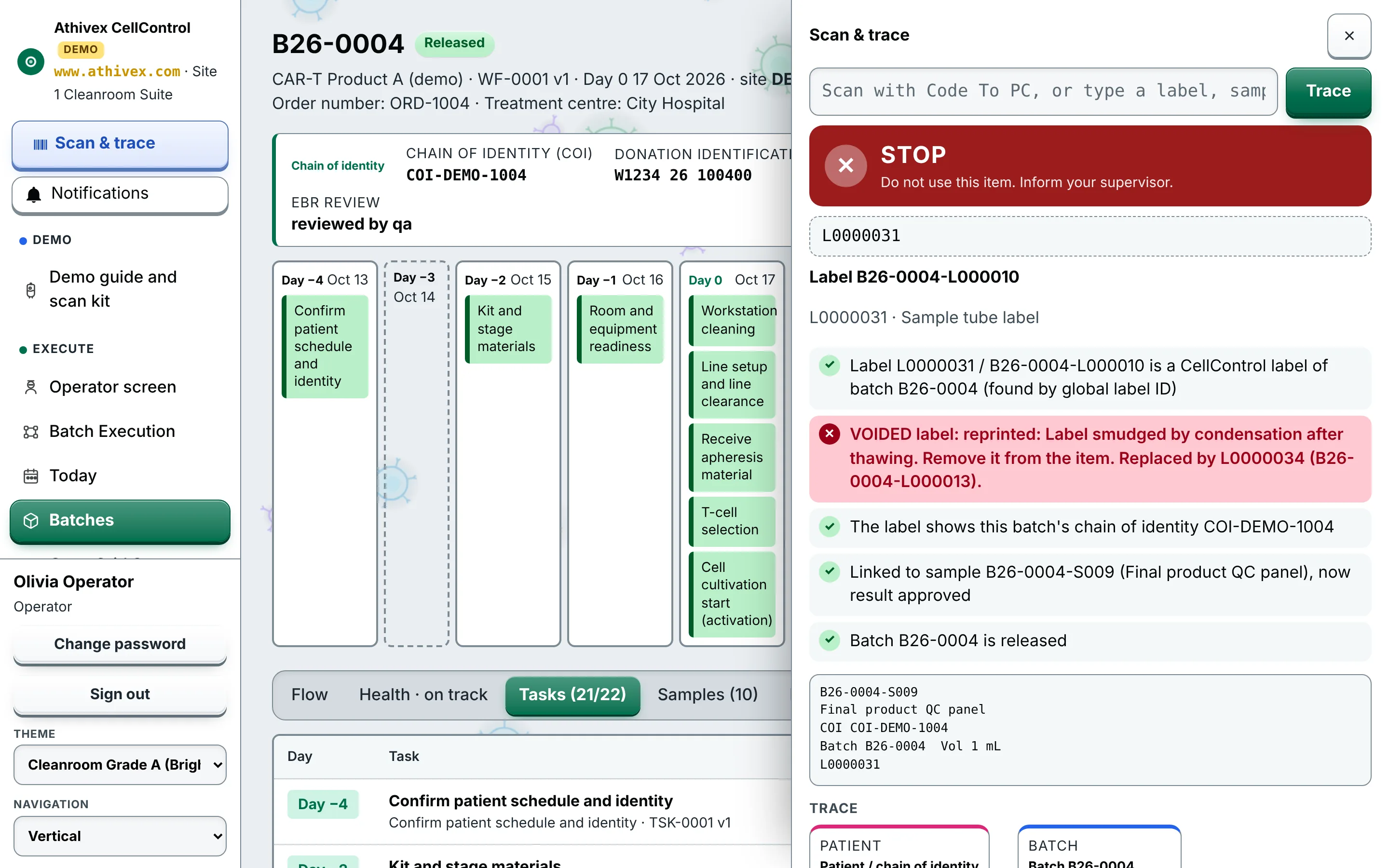
One scan tells the operator whether an item may be used
Scanning a label, sample tube or batch shows a clear verdict. Here a voided label is caught: the screen names the replacement label and links the item back to its sample, batch and patient.
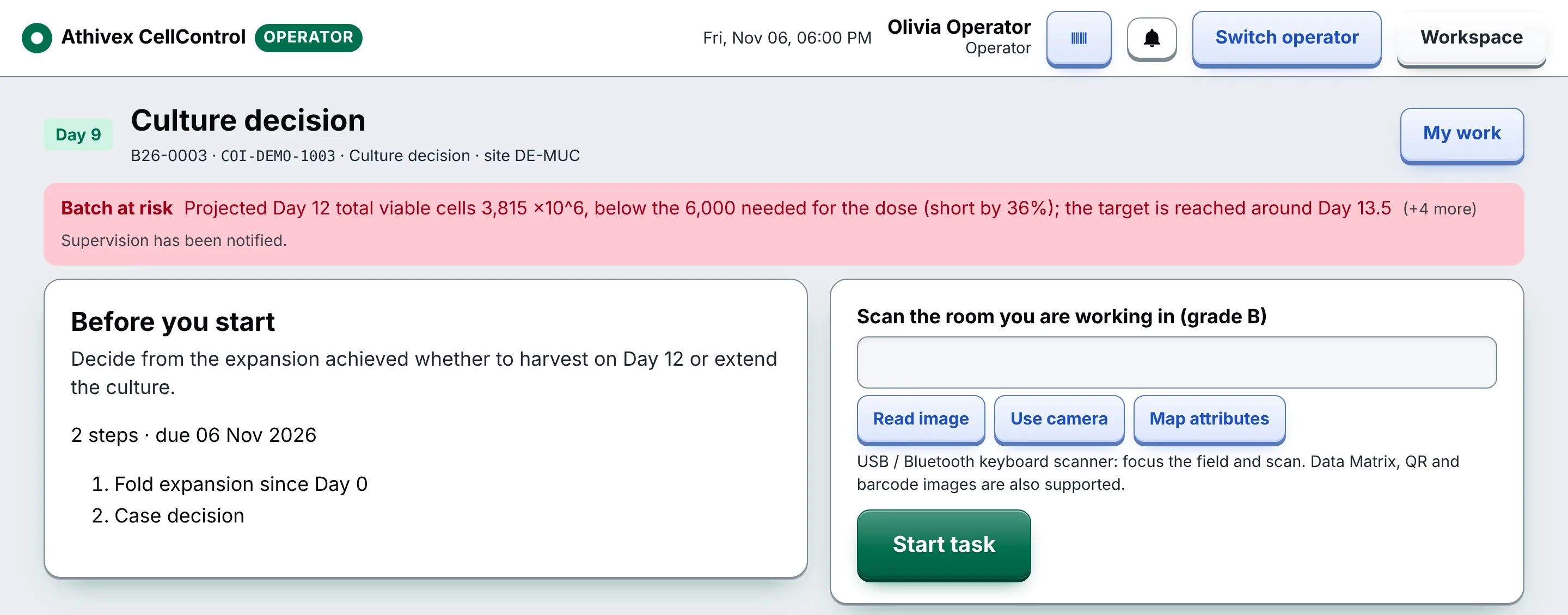
Guided steps on a cleanroom touch screen
Operators see only the work that is ready for them, with large controls for gloved hands. When a batch is at risk, the warning is on the task itself and supervision has already been notified.
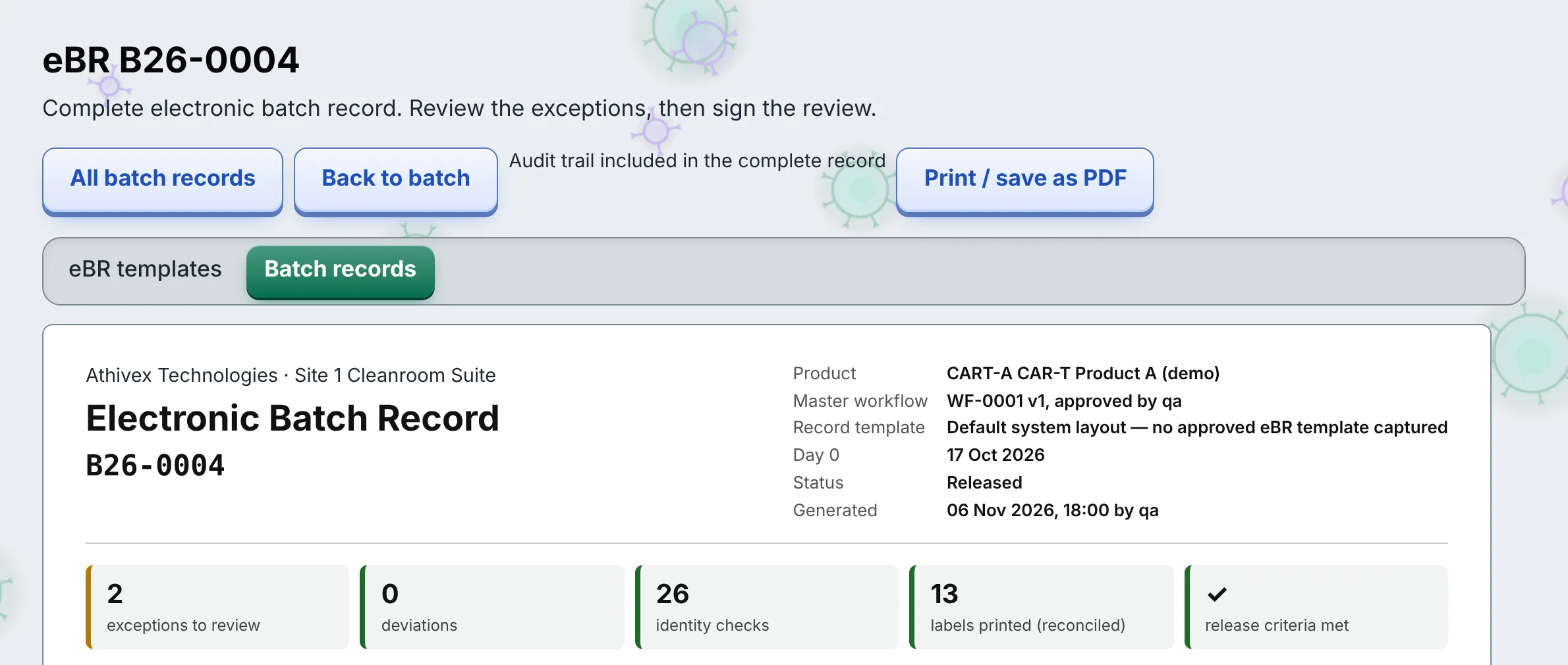
A complete batch record, reviewed by exception
The electronic batch record brings together steps, identity checks, deviations, label reconciliation and QC results, and lists the exceptions QA needs to look at before release.
How a pilot works
We are accepting two pilot partners for 2027: cell therapy developers or CDMOs that want to run their own process in CellControl before deciding on a site deployment.
Demo on your process
A one-hour session walking a CAR-T batch from apheresis receipt to release, using fictitious data.
Pilot on a hosted sandbox
Your product recipe, labels and one process configured in a private environment for your team to run test batches.
Decide on deployment
Hosted or on-premise at your site. Computerised-system validation is planned with your QA team for that installation.
Pilots run under a written agreement covering confidentiality and the use of your process information. Please do not send patient data at any stage before an agreement is in place.
Cell therapy software: common questions
New to electronic batch records for cell therapy? Read our practical guide to cell therapy manufacturing software.
What is CellControl?
CellControl is electronic batch record (eBR) and manufacturing execution software for cell therapy, made by ATHIVEX. It guides operators through each step on a cleanroom touch screen, carries the patient's chain of identity through every task, sample and label, checks items when they are scanned, and brings everything together in one batch record for QA review and release.
Which cell therapy processes does it support?
CellControl was built first for autologous CAR-T and CAR-NK manufacturing. Process steps, product recipes, sample types and labels are configured per product, so other cell-processing workflows such as allogeneic sub-lots, viral vector runs and cell banking can also be modelled. A pilot is the way to confirm the fit for your own process.
Is CellControl compliant with 21 CFR Part 11 and EU GMP Annex 11?
CellControl is designed to support the controls those regulations expect: individual user accounts, electronic signatures that record their meaning, a complete audit trail and role-based access. Compliance also depends on how a system is validated and used, so computerised-system validation is carried out for each installation by the manufacturer, and ATHIVEX supports that work.
How does CellControl protect the chain of identity?
The patient's chain-of-identity number is carried on every task, sample and label of the batch. When a label or sample is scanned, CellControl checks the label's status, its batch sequence number, the linked sample and the chain of identity. If anything does not match, or the label has been voided, the operator sees a STOP message and supervision is notified.
Can CellControl predict whether a batch will reach its dose?
CellControl compares each in-process cell count with the ranges in the approved product recipe and projects the count expected at harvest, for example on Day 10 or Day 12. When the projection falls short of the dose, the batch is flagged as at risk and supervision is notified, so the culture decision can be made with the numbers in front of the team. The projection supports, and does not replace, the team's judgement.
Can CellControl run on-premise?
Yes. CellControl runs in a web browser and can be used in a hosted pilot environment or installed on-premise at the manufacturing site.
How can we try CellControl?
Book a demo through the contact form on athivex.com and choose CellControl. ATHIVEX is accepting two pilot partners for 2027. Pilots run under a written agreement, and no patient data should be shared before that agreement is in place.